
A fast-growing city with a New Deal core
Spray Foam Insulation in Trussville, AL
Half the homes date from 1990 to 2009, but the historic Cahaba Project houses need their own approach.
- Free on-site estimates
- Written quote naming the foam, thickness and R-value for each area
- Moisture, leaks and termite access checked before anything gets covered
Two Very Different Kinds of Trussville House
Spray Foam Insulation in Trussville covers two very different housing stocks. Most of the city is new: Point2Homes' summary of 2019-2023 Census survey data puts the median year built at 1999, with 23.8% of homes built in the 1990s and 28.3% from 2000 to 2009. The population rose from 3,507 in 1980 to 26,123 in 2020. At the center of town, though, sits the Cahaba Project, a planned community built by the federal Resettlement Administration in the late 1930s.
The Cahaba Project houses
The Cahaba Project's plan, designed by local landscape architect W. H. Kestler and approved in 1936, produced 243 single-family houses and 44 duplexes. Most were American four-square houses with brick and wood siding, pine floors and metal roofs, and the district was added to the National Register of Historic Places in 2006. Four-squares have simple, boxy attics, which are easy to seal and insulate from the attic floor. Their walls, raised floors and metal roofs need more thought. We fill closed walls with dense-pack cellulose, look carefully at the crawl space, and treat any attic under a metal roof as a hot space that needs a well-sealed ceiling below it.
Newer subdivisions
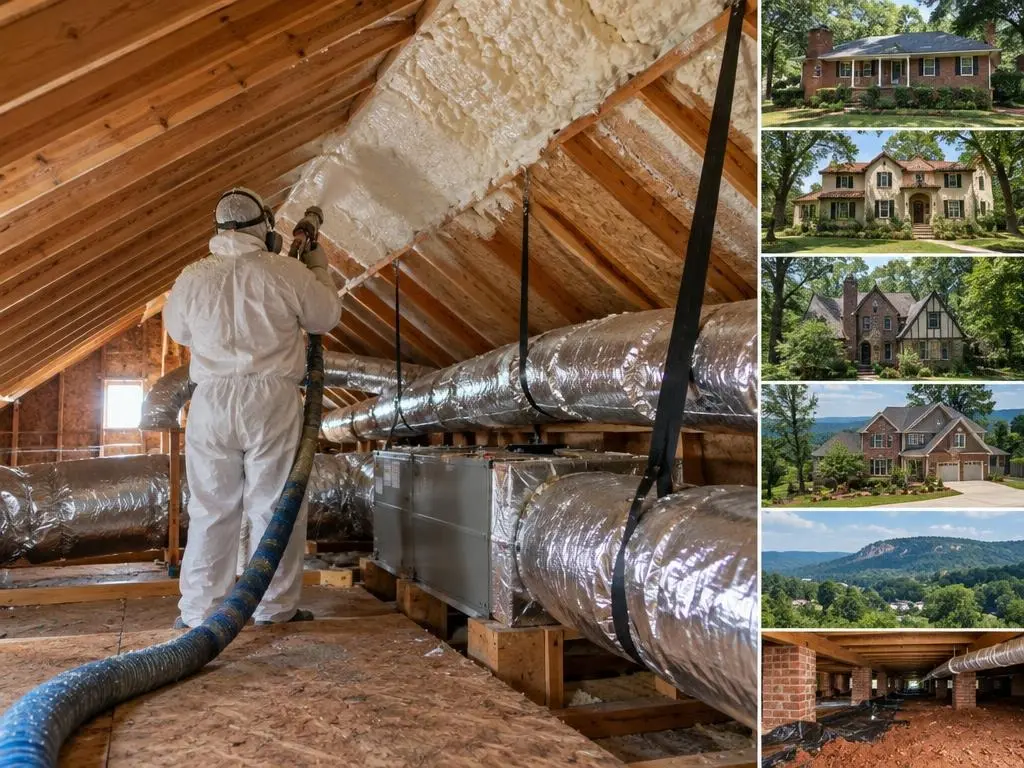
Trussville's 1990s and 2000s houses, spread across Jefferson and St. Clair counties, typically have the air handler and ductwork in the attic, a mix of vaulted and flat ceilings and often a bonus room. Attic insulation in these houses has had 20 to 30 years to settle. Many were built before Alabama's 2016 code update, which, as summarized by Alabama Power, made a blower door test under 5 air changes per hour mandatory for new homes. That means air sealing was often left undone.
What we usually recommend
For the newer houses, the choice is usually between sealing the attic floor and topping up with blown-in insulation, or encapsulating the roofline if the ducts are in rough shape. For the Cahaba Project houses and other older homes near the Cahaba River, where Warren Truss built his grist mill in 1821, the focus shifts to walls and the space under the floor.
Homes still being built
About 3.9% of Trussville's homes were built in 2020 or later. If you are building or finishing a basement, call before the drywall goes up. Open walls are the cheapest moment to fill them with foam.
Basements in the newer subdivisions
Some of Trussville's 1990s and 2000s houses were built on sloped lots with full or partial basements, often left unfinished at first and finished later. Before framing goes up in a basement, closed-cell spray foam on the concrete walls and the rim joist is the most reliable way to insulate and slow the moisture that comes through masonry. Fiberglass batts pressed against a basement wall in this climate can trap damp air and grow mold.
Tell us which part of Trussville you are in and the age of the house, and we will set up a visit. Get a free estimate
What to Know in Trussville
- Housing age. Point2Homes' summary of 2019-2023 ACS data gives a median year built of 1999, with 52.1% of homes built from 1990 through 2009.
- Cahaba Project. Built in the late 1930s by the federal Resettlement Administration: 243 single-family houses and 44 duplexes, mostly four-squares with metal roofs; listed on the National Register in 2006.
- Growth. Trussville grew from 3,507 residents in 1980 to 26,123 in 2020; the 2020 census counted 9,492 housing units with 3.4% vacant.
- Counties and zone. Trussville lies in Jefferson and St. Clair counties, both listed in IECC Climate Zone 3A.
Trussville Questions
Can you insulate a Cahaba Project house without changing its historic look?
Yes. Attic and crawl space work is out of sight, and walls can be filled from inside through small, patched holes. We discuss the approach before starting.
My 2000s Trussville house has a hot master bedroom. What can help?
Often it sits under a vaulted ceiling or next to attic kneewalls with gaps. Sealing those areas and adding insulation, or encapsulating the attic, usually helps. We look first.
Is spray foam good for finishing a basement in Trussville?
Closed-cell foam on basement walls and rim joists insulates and slows moisture through the concrete, which suits a finished space. We price it before framing goes up.
Do you cover the St. Clair County side of Trussville?
Yes, all of Trussville.
What does spray foam insulation cost for a basement?
HomeGuide lists closed-cell foam at $3.00 to $5.00 per square foot nationally, and rim joists at $2,000 to $2,500. Wall height and prep change the total. We give you a written estimate after measuring.
Free Estimates in Trussville, AL
Free estimates across Trussville, old and new.
Spray Foam Insulation Near Trussville
- Spray Foam Insulation in Birmingham, AL
- Spray Foam Insulation in Hoover, AL
- Spray Foam Insulation in Vestavia Hills, AL
- Spray Foam Insulation in Mountain Brook, AL
- Spray Foam Insulation in Homewood, AL
- Spray Foam Insulation in Bessemer, AL
- Spray Foam Insulation in Pelham, AL
- Spray Foam Insulation in Alabaster, AL
- Spray Foam Insulation in Helena, AL
- Spray Foam Insulation in Gardendale, AL
- Spray Foam Insulation in Center Point, AL
- Spray Foam Insulation in Irondale, AL
- Spray Foam Insulation in Leeds, AL
- Spray Foam Insulation in Chelsea, AL
- Spray Foam Insulation in Hueytown, AL
- Spray Foam Insulation in Fultondale, AL
- Spray Foam Insulation in Moody, AL
- Spray Foam Insulation in Calera, AL
- Spray Foam Insulation in Pleasant Grove, AL