
Older walls, new walls, additions
Wall Insulation in Birmingham, AL
Fill empty or half-empty walls in older houses, or get new walls right before the drywall goes on.
- Free on-site estimates
- Written quote naming the foam, thickness and R-value for each area
- Moisture, leaks and termite access checked before anything gets covered
Empty Walls in Older Birmingham Houses
Wall insulation is easy to overlook because you cannot see it. Many older Birmingham houses were built when insulating walls was not standard, and Point2Homes' summary of 2019-2023 Census survey data shows 18.3% of the city's homes date to 1939 or earlier and roughly 43% to before 1960. A house from that era may have plaster walls with empty cavities, or insulation that has slumped to the bottom of each bay. Those walls let in summer heat and let out winter warmth, and they often feel warm to the touch on an August afternoon.
Finished walls: filling from outside or inside
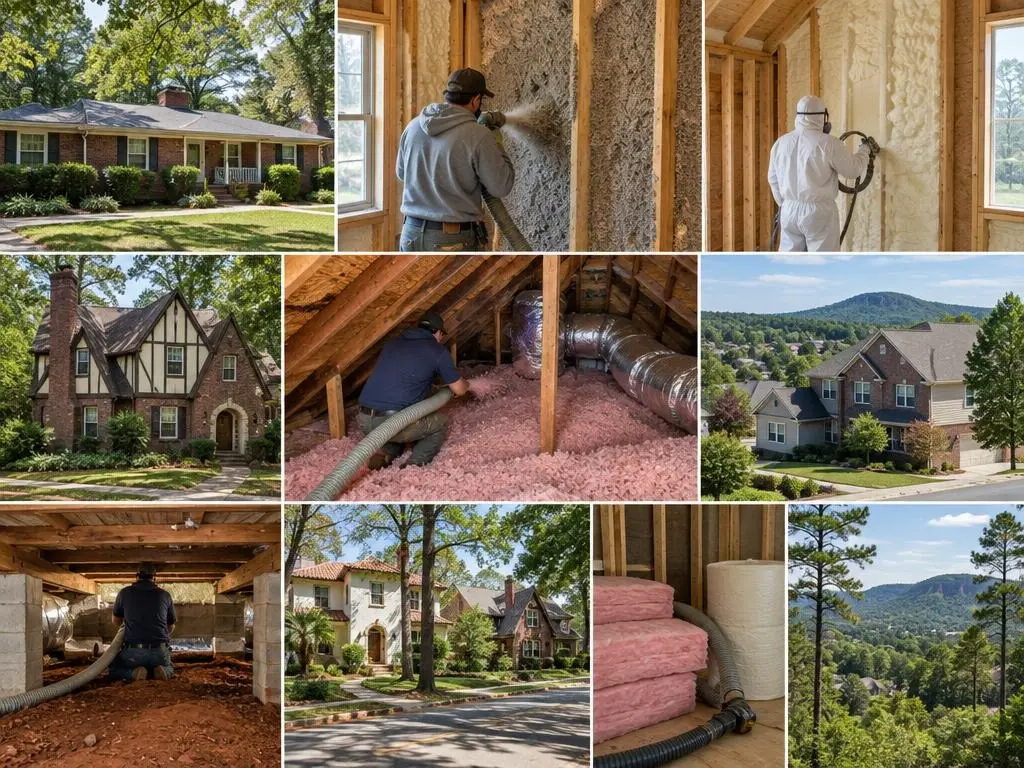
For walls that are already closed up, the usual approach is to drill a small hole in each stud bay, from outside under the siding or from inside through the plaster or drywall, and fill the cavity. Dense-pack cellulose is blown in at high density so it fills the cavity, resists settling and slows air movement. Injection foam is a low-expansion foam made for closed cavities. Both work; dense-pack is usually the lower-cost option. The holes are plugged and patched afterward, and on brick veneer houses we often work from inside.
New walls and additions
When studs are open, during a remodel, an addition or new construction, it is the easiest moment to insulate well. Alabama's amended 2015 code, as Alabama Power summarizes it, lists R-13 for walls. The Department of Energy's recommendation for a Zone 3 wall is R-20, or R-13 plus R-5 of continuous insulation. At HomeGuide's R-values per inch, open-cell foam filling a 3.5-inch 2x4 cavity reaches about R-12 to R-13, and closed-cell at the same depth reaches roughly R-17 or more, while also sealing the wiring and plumbing holes that batts leave open. We write the depth and R-value for each wall on the quote.
Walls between living space and attic
Some of the worst walls in a house are not exterior walls at all. Kneewalls behind bonus rooms and upstairs bedrooms, and walls between the house and an attached garage, often have batts that are loose or missing their backing. In summer they let attic heat straight into the room. We foam or re-insulate these walls and add a rigid backing where air has been washing through the batts.
Before we fill a wall
We check what is already in the cavity, look for knob-and-tube wiring in very old houses (which should be evaluated by an electrician before walls are filled), and look for signs of moisture from leaks or failed flashing. Filling a wall that gets wet from outside can trap the water. If we find a problem, we tell you before quoting.
Let us know how old the house is and which rooms feel worst, and we will check the walls and price the options. Get a free estimate
What Wall Work Covers
Options for walls that are open and walls that are already finished.
Dense-pack cellulose
Blown into closed wall cavities through small holes that are plugged and patched.
Injection foam
Low-expansion foam made for filling finished walls.
Open-wall spray foam
Open-cell or closed-cell foam in exposed stud bays during remodels, additions and new builds.
Kneewalls and garage walls
Foam or re-insulation of walls that face an attic or an unconditioned garage.
Published Wall Insulation Costs
| Job | Range and source |
|---|---|
| Spray foam, existing walls / new construction | $3.15 to $7.50 / $2.75 to $6.50 per sq ft (Fixr) |
| Spray foam, all exterior walls | $4,000 to $10,000 (HomeGuide) |
| Blown-in, exterior walls | $1,900 to $7,800, $1.10 to $3.70 per sq ft (HomeGuide); $2,000 to $4,000 (Fixr) |
| Dense-pack cellulose | $1.60 to $4.20 per sq ft (HomeGuide) |
| Open-cell / closed-cell, per sq ft | $1.50 to $3.50 / $3.00 to $5.00 (HomeGuide) |
National ranges from HomeGuide (2026 spray foam guide, November 2025 blown-in guide) and Fixr (2025). Siding or plaster type, wall height, how many cavities are blocked and patching needs all change the total. What you pay is what our written estimate says.
How It Works
1. Check the walls
We look inside a few cavities, check wiring and look for moisture or leak signs.
2. Pick the method
Dense-pack, injection foam or open-wall spray foam, written on the quote with the reason.
3. Fill the cavities
Each stud bay is filled, with blocked bays found and handled.
4. Patch and clean
Holes are plugged and patched, and the work area is cleaned.
Wall Insulation Questions
Can you insulate walls without tearing out drywall or plaster?
Yes. Dense-pack cellulose and injection foam both go in through small holes in each stud bay, drilled from outside or inside. The holes are plugged and patched when we finish.
How do I know if my walls have insulation?
Pull the cover off an outlet on an exterior wall and look with a flashlight, or we can check a few cavities during the visit. In very old Birmingham houses, empty walls are common.
Is spray foam worth it in new construction walls?
It costs more than batts, but it fills the cavity completely and seals the gaps around wiring and plumbing, which helps new homes pass Alabama's blower door test. We price foam and alternatives so you can compare.
Can you insulate a brick house's walls?
Usually, working from inside through small holes or during a remodel. Brick veneer has an air gap behind it that should stay open, so we fill the stud cavities only.
Wall Insulation Service Areas
- Spray Foam Insulation in Birmingham, AL
- Spray Foam Insulation in Hoover, AL
- Spray Foam Insulation in Vestavia Hills, AL
- Spray Foam Insulation in Mountain Brook, AL
- Spray Foam Insulation in Homewood, AL
- Spray Foam Insulation in Trussville, AL
- Spray Foam Insulation in Bessemer, AL
- Spray Foam Insulation in Pelham, AL
- Spray Foam Insulation in Alabaster, AL
- Spray Foam Insulation in Helena, AL
- Spray Foam Insulation in Gardendale, AL
- Spray Foam Insulation in Center Point, AL
- Spray Foam Insulation in Irondale, AL
- Spray Foam Insulation in Leeds, AL
- Spray Foam Insulation in Chelsea, AL
- Spray Foam Insulation in Hueytown, AL
- Spray Foam Insulation in Fultondale, AL
- Spray Foam Insulation in Moody, AL
- Spray Foam Insulation in Calera, AL
- Spray Foam Insulation in Pleasant Grove, AL
Get a Wall Insulation Estimate
Have your walls checked and get a written quote for the method that fits.