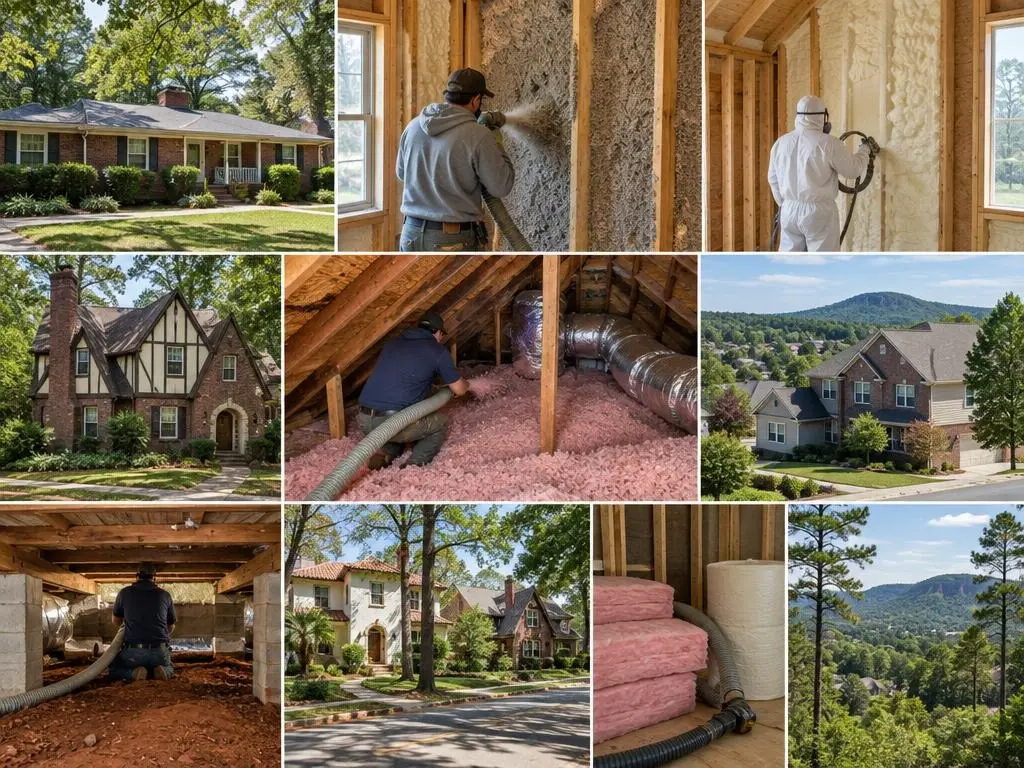
Mid-century homes on the slopes of Shades Mountain
Spray Foam Insulation in Vestavia Hills, AL
About half the city's homes date from 1950 to 1979, and their insulation shows it.
- Free on-site estimates
- Written quote naming the foam, thickness and R-value for each area
- Moisture, leaks and termite access checked before anything gets covered
Houses From the City's First Three Decades
Spray Foam Insulation in Vestavia Hills often starts with a house from the city's first building boom. Residential development here began in 1946, when Charles Byrd laid out a subdivision on the southern flank of Shades Mountain, and the city incorporated on November 8, 1950. Point2Homes' summary of 2019-2023 Census survey data shows 16.7% of homes built in the 1950s, 16.6% in the 1960s and 18.2% in the 1970s, for a median year built of 1978.
The mountain shapes the house
The city is named for former Birmingham mayor George B. Ward's estate on the crest of Shades Mountain, where his 1925 mansion was modeled on Rome's Temple of Vesta. The terrain that gave the city its views also shaped its houses. Many sit on sloped lots, with a partly exposed basement or a crawl space that is shallow at one end and tall at the other. Those foundations take in moisture from the uphill side, and the exposed walls on the downhill side lose heat in winter and gain it in summer.
Mid-century attics and walls
Houses from the 1950s through the 1970s were built when a few inches of attic insulation was considered plenty. Today that layer has settled, been walked on or been disturbed by cable and electrical work. The Department of Energy recommends adding R-38 to R-49 where 3 to 4 inches already cover a Zone 3 attic. Wall cavities in homes from that era may have thin batts or nothing at all, and brick veneer homes usually have to be insulated from inside.
Basements and crawl spaces on hillsides
For a partly buried basement, closed-cell spray foam on the walls and rim joists insulates and slows the moisture coming through the masonry. In crawl spaces we look closely at drainage, since water from uphill often finds its way under the house. Sealing and encapsulating a crawl space here only works once the water has somewhere else to go.
Newer Vestavia Hills
The city has also grown through annexation and new development, including Cahaba Heights and Liberty Park, and about 12.5% of homes were built from 2000 to 2009. Those houses usually have their ducts in the attic and benefit most from attic sealing or encapsulation.
Split levels and additions
Houses built in the 1960s and 1970s often grew over the years with a den, sunroom or second-story addition. Where old and new framing meet, there is usually a gap that leaks air into the attic or the crawl space, and the addition may have its own short attic or low-slope roof with little room for insulation. We check each section of the house separately, since an addition from the 1990s and the original 1950s core rarely need the same treatment. The quote lists each part on its own line, so you can decide what to do now and what to leave for a later remodel.
Tell us the year your house was built and whether it has a basement or crawl space, and we will come look. Get a free estimate
What to Know in Vestavia Hills
- Housing age. Point2Homes' summary of 2019-2023 ACS data gives a median year built of 1978, with 51.5% of homes built from 1950 through 1979.
- First subdivision. Residential development began in 1946 with Charles Byrd's subdivision on the southern flank of Shades Mountain; the city incorporated November 8, 1950 (Wikipedia).
- Housing units. The 2020 census counted 15,883 housing units in Vestavia Hills with 4.4% vacant; the 2010 homeownership rate was 76.8%.
- Attic target. For a Zone 3 attic that already holds 3 to 4 inches, the Department of Energy recommends adding R-38 to R-49.
Vestavia Hills Questions
My Vestavia Hills house has a partly finished basement. Can you foam the walls?
Yes, on unfinished sections or before finishing. Closed-cell foam on the masonry and rim joists insulates and slows moisture. Finished sections can be addressed during a remodel.
How much attic insulation should a 1960s house have?
The Department of Energy recommends adding R-38 to R-49 where an existing Zone 3 attic has 3 to 4 inches. Most houses from that era fall short, and we measure yours during the visit.
Water gets into my crawl space after heavy rain. Can encapsulation fix it?
Not on its own. The water source needs handling first, usually gutters, grading or drainage on the uphill side. Then encapsulation keeps the space dry.
Do you work in Cahaba Heights and Liberty Park?
Yes. We cover all of Vestavia Hills, including the newer areas.
How much does spray foam insulation cost for a Vestavia Hills attic?
HomeGuide's national figures put spray foam in an attic at $3,000 to $8,000, and open-cell on the roof deck at $1.50 to $3.50 per square foot. Roof size, pitch and foam thickness change the total. Your written estimate is the price.
Free Estimates in Vestavia Hills, AL
Free on-site estimates throughout Vestavia Hills.
Spray Foam Insulation Near Vestavia Hills
- Spray Foam Insulation in Birmingham, AL
- Spray Foam Insulation in Hoover, AL
- Spray Foam Insulation in Mountain Brook, AL
- Spray Foam Insulation in Homewood, AL
- Spray Foam Insulation in Trussville, AL
- Spray Foam Insulation in Bessemer, AL
- Spray Foam Insulation in Pelham, AL
- Spray Foam Insulation in Alabaster, AL
- Spray Foam Insulation in Helena, AL
- Spray Foam Insulation in Gardendale, AL
- Spray Foam Insulation in Center Point, AL
- Spray Foam Insulation in Irondale, AL
- Spray Foam Insulation in Leeds, AL
- Spray Foam Insulation in Chelsea, AL
- Spray Foam Insulation in Hueytown, AL
- Spray Foam Insulation in Fultondale, AL
- Spray Foam Insulation in Moody, AL
- Spray Foam Insulation in Calera, AL
- Spray Foam Insulation in Pleasant Grove, AL