
Open cell or closed cell, matched to the spot
Spray Foam Insulation in Birmingham, AL
Foam that fills the gaps, stops the air and keeps humid summer air where it belongs: outside.
- Free on-site estimates
- Written quote naming the foam, thickness and R-value for each area
- Moisture, leaks and termite access checked before anything gets covered
Insulation and Air Sealing in a Single Layer
Spray foam insulation goes on as a liquid and expands into a solid that fills every crack in the surface it touches. That makes it different from batts and loose fill, which slow heat but let air pass through them. In a Birmingham house, where summer air is hot and wet and the airport averages 70.4% relative humidity across the year, stopping that air is half the job. A foamed roof deck, crawl space wall or rim joist keeps the heat out and keeps humid air from reaching cool surfaces where it can condense.
Open cell vs closed cell
The two types of foam behave differently, and choosing the wrong one is the most common mistake we see.
Open-cell foam is light and soft to the touch. HomeGuide lists it at roughly R-3.5 to R-3.7 per inch. It expands a great deal, so it fills odd-shaped rafter bays and wall cavities well, and it costs less per square foot. It blocks air but lets some water vapor through, which can be useful under a roof deck because a small leak can dry out and show itself instead of hiding.
Closed-cell foam is dense and rigid, and HomeGuide puts it at roughly R-5 to R-7 per inch. At typical thickness it acts as a vapor retarder, it does not soak up water, and it adds some stiffness to what it is sprayed on. It costs more per square foot, so we use it where its strengths matter: crawl space walls, rim joists, the underside of floors over damp ground, metal buildings and any surface where moisture is a risk.
Where foam makes sense in Birmingham homes
- Under the roof deck, to bring a hot attic and the ductwork in it inside the insulated shell.
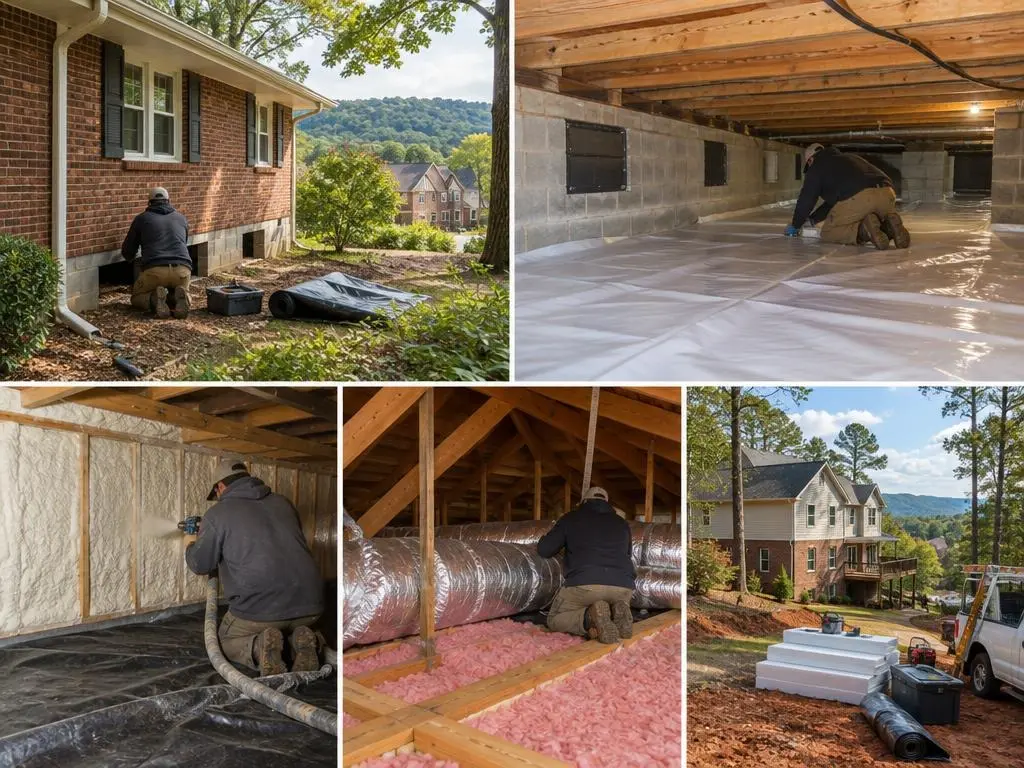
- Crawl space walls and rim joists, to close a damp, vented crawl space.
- Kneewalls and bonus rooms over garages, which run hot in summer because their framing leaves gaps that batts never fill.
- New walls and additions, where open studs make it easy to fill each cavity completely.
- Garages, shops and metal buildings, where closed-cell stops condensation dripping from cold steel on winter mornings.
Where foam is not the answer
We do not recommend foam everywhere. A wide, open attic floor with nothing in it but joists is usually cheaper to fix by air sealing the gaps and blowing cellulose or fiberglass to depth. Finished walls in older houses are often better filled with dense-pack cellulose through small holes than with injection foam. When two approaches would both work, the quote shows both prices.
The code and the targets
Alabama's amended 2015 energy code, as summarized by Alabama Power, lists R-30 for ceilings and R-13 for walls, and it treats R-20 of spray foam as meeting the ceiling requirement in a sealed, semi-conditioned attic. New houses must pass a blower door test under 5 air changes per hour at 50 pascals, and foam is one of the most direct ways to get there. Our quote lists the foam type and thickness for each area so you can see the R-value you are paying for.
Safety during and after the job
Spray foam is mixed on site from two components, and the fumes while it cures are the reason everyone else stays out. HomeGuide advises planning to be out of the house for at least 24 hours. We close off the work area, ventilate it and cover nearby surfaces. Foam left exposed inside living space or in some attics needs a thermal or ignition barrier depending on the product and the location, and we explain what applies to your house before we start.
Tell us which parts of the house bother you most, and we will look at them and price each area separately. Get a free estimate
What This Covers
Foam work we do in houses, additions and outbuildings around Birmingham.
Open-cell roof deck foam
Sprayed under the roof sheathing and gable walls to seal and insulate an attic that holds ducts or equipment.
Closed-cell crawl space and rim joist foam
Dense foam on foundation walls and band joists where damp air and ground moisture are the risk.
New construction and addition walls
Open stud bays filled with open-cell or closed-cell foam before drywall, sized to the wall depth.
Garages, shops and metal buildings
Closed-cell on steel panels, purlins or framed walls to insulate and stop condensation.
Published Spray Foam Insulation Costs
| Job | Range and source |
|---|---|
| Spray foam, installed | $1.50 to $5.00 per sq ft (HomeGuide) |
| Open-cell / closed-cell | $1.50 to $3.50 / $3.00 to $5.00 per sq ft (HomeGuide) |
| About 1,000 sq ft | $1,500 to $5,000 (HomeGuide); $3,150 to $7,500 in an existing home (Fixr) |
| Existing walls / new construction | $3.15 to $7.50 / $2.75 to $6.50 per sq ft (Fixr) |
| All exterior walls | $4,000 to $10,000 (HomeGuide) |
| Whole house | $8,000 to $20,000 (HomeGuide); $10,000 to $30,000 (Fixr) |
| Common job minimum | $1,000 to $2,000+ (HomeGuide) |
Figures are national ranges from HomeGuide's 2026 spray foam guide and Fixr's 2025 guide, not Birmingham quotes. Foam type, thickness, access and prep work move your total, and small jobs often land on a minimum. The number we write on your estimate is the number you pay.
How It Works
1. Inspection
We look at the attic, crawl space and walls, check for leaks and moisture, and measure the areas.
2. Written quote
Each area gets its foam type, thickness, R-value and price, with any prep or removal listed separately.
3. Prep and spraying
We cover and mask, seal off the work area, then spray to the thickness on the quote.
4. Cure and walk-through
After the foam cures and the area is ventilated, we check thickness and coverage with you and clean up.
Spray Foam Insulation Questions
Is closed cell or open cell better for a Birmingham attic?
For the underside of a roof deck, open-cell is the more common choice here. It costs less, fills rafter bays well, and lets a roof leak show itself instead of trapping the water. Closed-cell makes more sense where moisture or limited depth is the issue.
Can spray foam go over old insulation?
Not on top of loose fill or batts in a way that does any good. Foam has to bond to the surface it seals. We remove or pull back old insulation where the foam needs to go, and list that work on the quote.
Does spray foam keep out bugs and termites?
Foam closes many gaps insects use, but termites can tunnel through it and it can hide their mud tubes. Alabama is in HUD's very heavy termite zone, so we leave the inspection areas your pest control company needs and talk with you about your termite contract before foaming a crawl space.
Will spray foam make my house too tight?
A tighter house is the goal, but it does need controlled fresh air and safe venting for gas appliances. We check for combustion appliances in the spaces we seal and tell you if ventilation changes are worth discussing with your HVAC contractor.
Spray Foam Insulation Service Areas
- Spray Foam Insulation in Birmingham, AL
- Spray Foam Insulation in Hoover, AL
- Spray Foam Insulation in Vestavia Hills, AL
- Spray Foam Insulation in Mountain Brook, AL
- Spray Foam Insulation in Homewood, AL
- Spray Foam Insulation in Trussville, AL
- Spray Foam Insulation in Bessemer, AL
- Spray Foam Insulation in Pelham, AL
- Spray Foam Insulation in Alabaster, AL
- Spray Foam Insulation in Helena, AL
- Spray Foam Insulation in Gardendale, AL
- Spray Foam Insulation in Center Point, AL
- Spray Foam Insulation in Irondale, AL
- Spray Foam Insulation in Leeds, AL
- Spray Foam Insulation in Chelsea, AL
- Spray Foam Insulation in Hueytown, AL
- Spray Foam Insulation in Fultondale, AL
- Spray Foam Insulation in Moody, AL
- Spray Foam Insulation in Calera, AL
- Spray Foam Insulation in Pleasant Grove, AL
Get a Spray Foam Insulation Estimate
Get open-cell or closed-cell foam priced area by area after a free visit.